
I try to dedicate a solid half hour to meditation every morning, right after I sing Lauds. I find that the quiet of the morning helps me to concentrate more deeply. I always start by taking inspiration from a book. Sometimes a quote is enough to enflame my heart with love of God, other times I have to read at length to squeeze out a drop of devotion. Such are the highs and lows of meditation.
Not all meditation books have the same effect: some are definitely better than others. Over the last few months, I’ve been reading one that has provided me with a wealth of good nourishment for the mind and heart. It’s called The Passion of Jesus Christ, and it’s by a Capuchin Friar named Gaetano of Bergamo.
It’s a lengthy book that chronologically describes the Passion of Our Lord, from His entrance into Jerusalem to His death on the Cross. It’s divided into small chapters, each focusing on a different aspect of the Passion, each meant to inspire good thoughts and devotion.
The friar who wrote this book masterfully blends vivid descriptions of the exterior events of the Passion with the interior movements of Christ’s heart through His sufferings. I found this latter part especially significant and interesting, because of the insight it provides into the holy soul of Jesus.
A recurring theme throughout these descriptions of Christ’s interior movements is the co-existence in his soul of contradictory feelings. On the one hand, we have the terrible agony produced by the manifold tortures, physical, emotional, and spiritual. Our Lord experienced atrocious pain, fear, sadness, and shame. Beginning with the agony in the garden and ending with his death, He is the man of sorrows. He was all suffering.
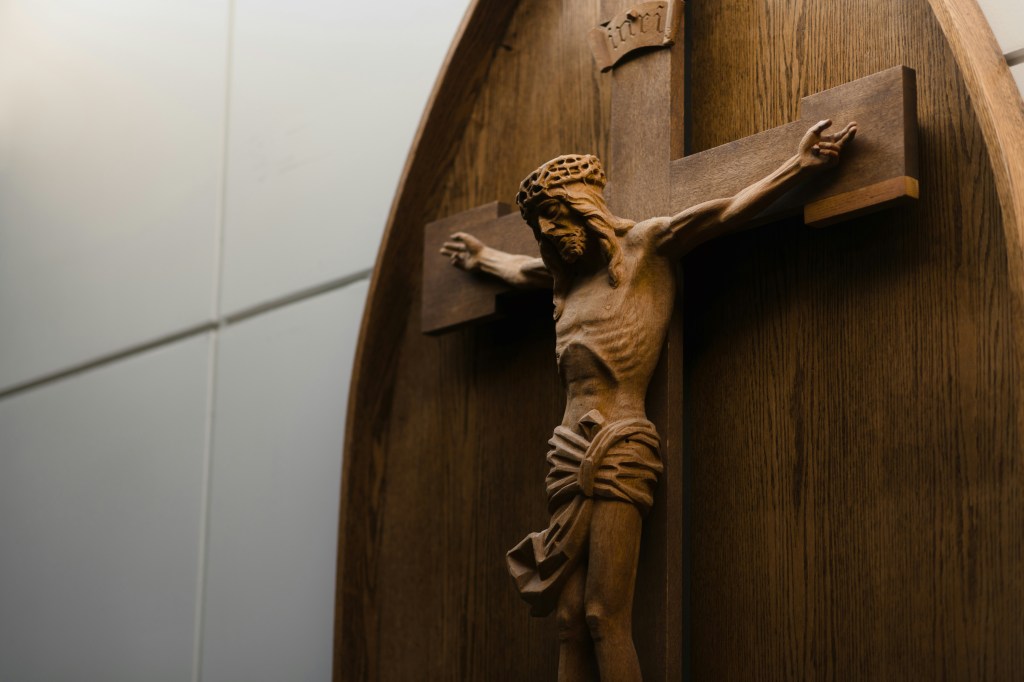
On the other hand, in the superior part of His blessed soul, Our Lord experienced a profound spiritual joy because he was fulfilling His Father’s will and redeeming the human race, which He loved so much. His ardent charity made Him desire all the torments of the Passion. Indeed, He had been waiting for it His whole life and was finally realizing the purpose of His incarnation.
Father Gaetano notes in several passages of his book that the spiritual joy Our Lord experienced in no way mitigated His sufferings. This was due to a special provision of the Divine Will. Christ’s joy and suffering co-existed perfectly in His soul, each incredibly intense. In fact, we cannot even begin to imagine the intensity of the feelings which Jesus experienced. His perfect human nature was exquisitely delicate, devoid of the corruption of original sin, which numbs the senses and dulls the mind. He knew and felt everything acutely.
The co-existence of joy and suffering in the soul of Jesus is one of the paradoxes that make Christianity so mysterious. It’s also a paradox that all Christians will eventually experience in their own lives if they take the Gospel message seriously.
Almost from the beginning of our existence, we learn that experiences can be divided into two categories: pleasurable and painful. We quickly learn to avoid the painful and desire the pleasurable. This comes easily. It’s a law built into our very nature that we all follow instinctively.
God gave us pleasure to direct us towards good things. For example, eating is pleasurable because it’s an activity that sustains our life, which is very good. When we eat, we are doing something we were designed to do, and that feels pleasant.

Unfortunately, due to original sin, our faculties are disordered, so using pleasure as an exclusive meter to gauge what is good and what isn’t is no longer reliable. Our appetites want too much and are often at war with what our reason directs us to. For example, we end up eating way more than we need just because eating feels good. The system is broken.
To repair the damage of original and actual sin, Our Lord chose to embrace the Cross. To do so, He had to go against the natural aversion to pain that is built into our human nature. By doing this, He was perfectly fulfilling His Father’s will. Thus we can say that since Our Lord’s coming, we will often find that in order to follow God’s will, we too must go against the inclinations of our nature. That is the meaning of “mortifying” yourself. Indeed, we die to our own nature in order to be resurrected in Christ.
This is the reason why as Christians we can often experience joy and suffering at the same time. The suffering comes from the evil we must endure, the joy comes from fulfilling God’s will. It is a supernatural joy that tells us we are on track. It is a transcendent good, meaning it is not dependent on fulfilling any natural desire.
In many ways, this joy tells us we have carved a space of freedom in our soul; freedom from this earthly home with its transient goods. We can feel this joy even if everything is taken from us, so long as we do not sever our connection with God.

Indeed, we find that this joy often comes to us in the middle of trials and tribulations, just as the rose blooms amidst a thousand thorns. Other times it can surprise us in the most ordinary circumstances of our lives, as we faithfully fulfill our daily duties. We can be surprised by this if we don’t realize how the perseverent carrying of our small daily crosses can produce such incredible results on our souls.
God designed us for this paradoxical joy. We are most alive when we accept death by a thousand daily blows. In true suffering lies true joy, and they are forever together in our fallen world. If we keep our eyes on Christ, we too shall experience this co-existence of contradictory feelings in our hearts.
Worldly people don’t understand this. They run from the Cross of Christ because they see in it only death. They cannot see the supernatural life contained there, which consists of doing the will of God. They will never taste the supernatural joy of this higher life and they will not know what it means to be divinized through suffering.
As Christians, we should know better than they do. Yet we often fail to live up to our beliefs and seek only after transient pleasures. When we do this, we are failing to nurture the supernatural life of grace in our souls.
We must not be afraid of the Cross. Just as it was for Christ, the joy we can experience in embracing it does not cancel out the suffering, which remains very real. Yet we gain much more than we lose. Through the Cross, we are born to a new life and a new identity as children of God.
We should all strive to meditate on the mysteries contained in Our Savior’s heart so that we might enter into them. By meditating on His suffering, we are reminded that sanctity is found only in the Cross. By meditating on His joy, we are led to discover that true happiness consists in doing the will of God always. When we bring these two things together, we have the Christian life in all its fullness, the Cross taken up for love of God.
 Tu Es Vita